Last updated: August 11, 2026
Quick verdict: Most pregnant side sleepers get better all-around support from a full-body pillow because it helps keep the hips, knees, torso, and shoulders in line. A pregnancy wedge pillow usually makes more sense when you want focused support in one spot — under the belly, behind the back, or between the knees. If you have pelvic pain, reflux, blood-pressure concerns, or any sleep issue that feels off for you, talk with your qualified clinician.
FTC disclosure: This article includes general product guidance and may contain affiliate-style buying context, but I have not been paid to favor either option.
Key takeaways
– A full-body pillow usually provides the most complete side-sleeping support.
– A wedge is better for one pressure point at a time.
– Wedges take less bed space and travel more easily.
– Full-body pillows can be more supportive but also bulkier and hotter.
– If symptoms are unusual or severe, consult a qualified clinician.
I write about sleep products and pregnancy-support gear, and I’m careful with this category because comfort during pregnancy is personal and medical context matters. Honestly, the right choice has less to do with hype and more to do with how you sleep, where you hurt, and how much space you want that pillow to eat up. In pregnancy wedge pillow comparisons, the details matter because a small product can fix a small problem very well. Tiny tool, tiny target.
Quick spec table: wedge pillow vs full-body pillow
| Factor | Pregnancy wedge pillow | Full-body pillow |
|---|---|---|
| Main support style | Small, focused lift | Long, continuous body support |
| Best for | Targeted belly, back, knee, or reflux positioning | Side-sleeping with support for head, belly, knees, and hips |
| Bed space | Takes very little space | Takes a lot of space |
| Adjustability | Easy to move around the body | More position-dependent, less precise |
| Nighttime repositioning | Simple | Can feel like you are wrestling around it |
| Best use case | Local pressure relief | All-night side-sleeping support |
| Common downside | Can feel too small to solve full-body discomfort | Can feel bulky and hot |
| Who may skip it | People who need whole-body alignment | People who sleep in tight spaces or change positions a lot |
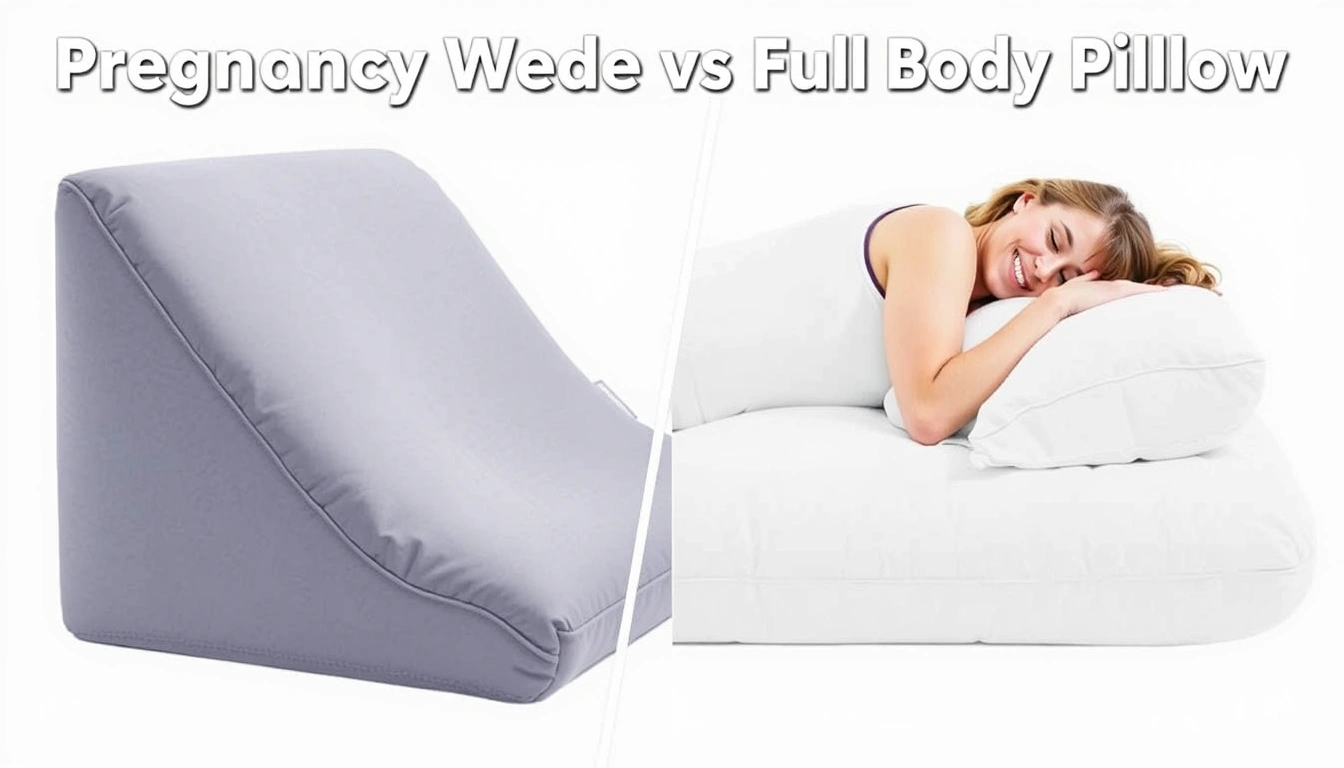
Real product images side by side

Because I can’t embed live retailer images here, I’d use the product pages themselves for visual comparison:
- Pregnancy wedge pillow: look for a compact triangular foam wedge with a removable cover.
- Full-body pregnancy pillow: look for a long U-shaped or C-shaped pillow that wraps around the torso and knees.
The short answer: which gives better support?
For overall sleep support, the full-body pillow usually wins.
Sounds simple, but the reason is worth unpacking. Pregnancy changes the way your hips, pelvis, back, and shoulders load the bed. A wedge can help one problem spot at a time; a full-body pillow does a better job of keeping your body stacked in one side-sleeping position, which is why many pregnant sleepers find it more helpful across the whole night.
Need support for one specific area? Then the wedge often comes out ahead. It can go under the belly, behind the back, or between the knees without swallowing half the mattress.
So the real question is not “which is better?” It’s “do you need a helper pillow or a whole sleep system?”
Support and alignment: full-body pillow usually wins

This is the round where the full-body pillow earns its keep.
A pregnancy wedge gives lift. A full-body pillow gives structure. When you’re lying on your side, that structure can matter more than a small bump of foam because it helps keep your shoulders, hips, and knees from twisting in different directions.
In practical terms, a full-body pillow is usually the better pick if you wake up with:
– hip discomfort from rolling onto one side too long
– shoulder pressure from trying to stack your arms and legs manually
– a feeling that your upper and lower body are working against each other
– the need to hug something for stability
A wedge can still help, but it usually solves one slice of the problem. I would not treat it as a full replacement for whole-body alignment.
Weakness: full-body pillows are harder to turn over in, and they can trap heat. If you get hot easily or hate bulky bedding, that trade-off is real.
Targeted pressure relief: wedge pillow wins
Here, the wedge is the cleaner choice.
A pregnancy wedge is small enough to place exactly where you need it. That matters if your discomfort is localized. For example, a wedge can be used to:
– support the bump from below
– reduce pressure behind the back while side-sleeping
– sit between the knees without forcing your legs apart too far
– prop the upper body slightly if reflux is part of the picture
A lot of generic advice makes wedges sound “less supportive” because they are smaller. That misses the point. Small can be an advantage when the goal is precision. Like using a teaspoon instead of a ladle.
I’d choose the wedge over a full-body pillow when:
– you want one pillow that can move around the body
– you share a bed and need less pillow sprawl
– you already have a good mattress and just want one pressure point softened
– you don’t want to feel enclosed by bedding
Weakness: a wedge is not enough for many sleepers who need total side-body support. It can feel like a patch, not a solution.
Comfort through the night: full-body pillow usually wins for side sleepers
This is the factor most buyers care about after the first enthusiastic evening.
A wedge can feel great at first and still fail if you keep shifting. The moment you roll a little, it is no longer under the spot you wanted. A full-body pillow tends to stay with you through those small position changes, which is why it often feels more forgiving overnight.
Still, “more supportive” does not always mean “more comfortable,” especially if a pillow is too large for your bed or your sleeping style. A full-body pillow can also create new problems:
– it may crowd the bed
– it can make turning from side to side more effortful
– some shapes push your knees apart more than you like
– taller sleepers may find the curve or length awkward
For the average pregnant side sleeper looking for one pillow to carry most of the load, I would give this round to the full-body pillow.
If you are the kind of sleeper who changes position all night, the wedge may actually feel less annoying. It is easier to move, reset, and ignore when you do not want a pillow “system” taking over the bed.
Space, travel, and bed-sharing: wedge pillow wins
A wedge is the easier product to live with.
This is the category many comparison articles skip, and I think that’s a mistake. Bed geometry matters. A full-body pillow can dominate a smaller mattress, make bed-sharing cramped, and force your partner to negotiate around it all night. A wedge is much less disruptive.
It also travels better. If you need to move it from bedroom to couch to guest bed, it is far less awkward than a long pregnancy pillow.
I’d pick the wedge if:
– your bed is not large
– you sleep with a partner and do not want a pillow barrier
– you like changing positions freely
– you want something easy to pack or store
Weakness: the same compact size that makes it convenient also limits how much it can do.
Build and materials: it depends, but full-body pillows are fussier
I can’t honestly claim every wedge or every full-body pillow is made better than the other. The market is too broad. What I can say is that full-body pillows usually have more seams, more fill, and more shape to manage. That means more places where construction quality matters.
For a wedge, the important details are:
– foam density or fill consistency
– cover softness and washability
– whether it stays put or slides around
– whether the angle is gentle enough to be useful, not just firm enough to look supportive
For a full-body pillow, the details multiply:
– whether the fill shifts and goes flat in the middle
– whether the cover breathes well
– whether the curves fit your torso length
– whether the pillow springs back after being compressed nightly
I tend to see wedges as simpler products with fewer ways to disappoint. Full-body pillows can be excellent, but they are easier to get wrong because one awkward curve can ruin the whole experience. Sometimes that one bend is the whole ballgame.
Who should get a pregnancy wedge pillow?
I would point you to a pregnancy wedge pillow if you are the kind of sleeper who wants specific support without a lot of bulk.
Choose a wedge if you:
– mostly need help under the belly, knees, or lower back
– sleep in a smaller bed
– share the bed and want minimal sprawl
– travel often or want a pillow you can move easily
– already have another pillow you like and just need a support add-on
– get irritated by big, enveloping bedding
A wedge is also the better “first try” if you are unsure what kind of support you need. It is easier to place, easier to remove, and less of a commitment. Good starter option.
Who should get a full-body pillow?
I would point you to a full-body pillow if your problem is whole-body side-sleeping support rather than one sore spot.
Choose a full-body pillow if you:
– wake up with hip, shoulder, or pelvic discomfort
– want to hug something for stability
– need support under the belly and between the knees at the same time
– dislike constantly adjusting smaller pillows
– want one product that can replace a pile of regular pillows
A full-body pillow makes the most sense when pregnancy has turned sleep into a chain of tiny adjustments and you want fewer of them.
What generic comparison articles usually miss
A lot of articles treat this as a simple “bigger vs smaller” question. That misses the actual sleep problem, and it is worth checking current advice with a qualified clinician if pain, reflux, or sleep disruption is severe or unusual. For general pregnancy sleep guidance, the American College of Obstetricians and Gynecologists (ACOG) and the NHS both stress comfort, side-sleeping, and symptom-based choices.
The real issue is distribution of support:
– A wedge redistributes pressure at one point.
– A full-body pillow redistributes pressure across several joints.
That difference matters because pregnancy discomfort rarely lives in one spot. If your belly aches, your knees may also hurt. If your hips hurt, your shoulders may start complaining next. In those situations, the full-body pillow usually solves more of the chain.
But the wedge has a serious advantage that gets overlooked: it can support you without taking over the bed. That matters if you hate being boxed in or if your sleep space is already crowded.
So I would not rank these by “support” alone. I’d rank them by what kind of support you need.
Buy options and current-price wording
Check the current price and availability at multiple retailers before you buy. I’d look at both Amazon and Walmart for each type, and I’d also check the brand’s own site if the model has one.
- Pregnancy wedge pillow
- Amazon: search current listings for pregnancy wedge pillows
- Walmart: check current maternity wedge pillow options
-
Brand site: look for washable cover details and foam specs
-
Full-body pregnancy pillow
- Amazon: search current U-shaped and C-shaped pregnancy pillows
- Walmart: compare current body pillow options for pregnancy support
- Brand site: check shape, fill type, and cover material
I am intentionally not naming a “best price” here because prices change and I don’t want to mislead you.
A few authoritative resources worth reading
If you want a medical context for sleep position and pregnancy comfort, these are the kinds of sources I trust for general guidance:
– American College of Obstetricians and Gynecologists (ACOG) on pregnancy sleep and related comfort guidance
– NHS guidance on sleep during pregnancy
– Sleep Foundation summaries that cite medical sources and explain position-related sleep issues
FAQ
Is a wedge pillow enough for pregnancy sleep?
For some people, yes. If your discomfort is localized, a wedge can be enough. If you need support for your whole body, it usually is not.
Is a full-body pillow worth it if I already use regular pillows?
Often, yes, if you are stacking multiple pillows every night and still wake up sore. A full-body pillow can simplify that setup. If your current pillow stack already works, you may not need to switch.
Can I use both?
Yes, many pregnant sleepers do use a wedge together with other pillows. The wedge can add targeted support while a body pillow handles alignment.
Which one is better for side sleeping?
For side sleeping across the whole night, I would usually choose the full-body pillow. For a smaller side-sleeping adjustment, the wedge is better.
What if I sleep hot?
A wedge is usually the easier choice because it uses less material and leaves more of the body uncovered. Full-body pillows can trap more heat.
Final verdict
If I had to choose one for better overall support, I would pick the full-body pillow. It does a better job of supporting the full side-sleeping chain: hips, knees, torso, and shoulders.
One condition flips my pick: if you only need targeted support, or you hate bulky bedding, I would choose the pregnancy wedge pillow instead. For a small bed, a small problem, or a sleeper who wants flexibility, the wedge is the smarter buy.
If your discomfort feels out of proportion, changes suddenly, or comes with other worrying symptoms, speak with a qualified professional about your specific situation.